
Petra Jordan Tour
Petra Jordan Tour 7 Days / 6 Nights
Amman, Ajloun, Jerash, Madaba, Mount Nebo, Karak, Dana, Petra, Wadi Rum, Dead Sea | Private Tour
Starting from
On request
Custom offer
7
Days
6
Nights
Petra
Main attraction
About Petra Jordan Tour
Journey back in time to the lost ancient Nabataean kingdom with a private one-week route through Jordan's essential highlights.
This trip will cover: Amman, Ajloun, Jerash, Madaba, Mount Nebo, Karak, Dana, Petra, Wadi Rum and the Dead Sea.
Please click on any day of the itinerary below for more information!
Tour Itinerary:
Day One - Airport Pickup
Upon your arrival, one of our team members will be expecting you (with a sign) at Queen Alia International Airport arrivals hall.
After initial greetings, you will be driven to your designated hotel in Amman (the drive should take no more than 30 minutes).
After check-in at the hotel, we will leave you to rest, relax and freshen up so you can be ready for the next day to embark on your journey.
Day Two - Castle of Ajloun – Jerash (ancient Gerasa) – Amman Highlight
After breakfast, we start out by heading north where we will visit our first spectacular site, Ajloun Castle. The drive should take around one and a half hours, and we will be covering 73 kilometres (passing the city of Jerash). Something that you will most certainly notice while driving towards Ajloun is how the landscape of Jordan changes from desert in the south, to lush green vegetation made up of pine tree forests and olive groves in the north. This is just one of the many characteristics of Jordan that makes it a wonderfully unique country.
A Brief History of Castle of Ajloun or Qalaat Errabadh (Arabic for "Hilltop Castle")
The original castle was built by the nephew of the great military leader Salah ad-Din al Ayyubi in 1184–85 as a military fortress to defend against Crusaders, as well as to protect valuable trade routes between Jordan and Syria.
The castle is an excellent example of medieval Arab-Islamic military architecture. The first thing you will notice as you are approaching Ajloun Castle are the massive walls and the five looming towers.
The castle was originally constructed with four towers, and in 1215 AD extended to include a fifth tower and a drawbridge.
You will cross over this medieval bridge, which allows you access across the moat and into the castle. Once inside you will find a maze of curved passageways; winding staircases; long ramps; huge rooms that functioned as dining halls; residences; and castle stables. From the top of the castle, you will enjoy panoramic views of the hilltops along the Jordan Valley.
Ajloun Castle entrance fee: 3 Jordanian dinars.
After you are satisfied with your castle visit, we will drive back towards the city of Jerash (approximately 45 minutes). Jerash contains the most well preserved Roman settlement in all of the Middle East and you will get a chance to gaze upon this special place that has survived thousands of years.
Overview of Sites for Ancient Jerash City
- Hadrian's Arch: you will enter the ancient Roman city through this oval arch. Built in 129 AD to mark Emperor Hadrian's visit, this stunning piece of architecture is considered as magnificent as the arch in the forum in Rome.
- Hippodrome: as you pass through the arch, to your left you will find the hippodrome or 'circus.' This stadium-like structure was used for horse and chariot races by the ancient Greeks and Romans. There is currently a show (The Roman Army and Chariot Experience) that replicates the events that took place here centuries ago.
- Forum (Oval Plaza): an asymmetrical plaza at the beginning of the column-laden street that runs the length of the city. It was once lined with the city's major buildings, shops, and residences.
- Agora: this was the city's main food market. Here you will see the nymphaeum (or central fountain).
- Nymphaeum: an ornate public fountain that was decorated with lions' head motifs and dedicated to the nymphs—mythological female deities of nature.
- Temple of Artemis: these impressive ruins are all that's left of the temple dedicated to the patron goddess of the city, Artemis.
- South Theatre: one of the only two theatres in Jerash to survive, the South Theatre is the largest. Here you will see a 1st century amphitheatre that seats up to 3,000. If you're lucky, you may catch the Jordanian military band playing there.
- Jerash Archaeological Museum: Jerash was a city hidden under centuries of sand that has only begun to be excavated in the last 70 years. The museum features a collection of artefacts found during these various excavations including coins, statues and sarcophagi.
Jerash City entrance fee: 10 Jordanian dinars.
Things to consider while in Jerash: The Roman Army and Chariot Experience (RACE)
The epic hippodrome race can now be seen for the first time in over a thousand years. Guests will enjoy the authentic replicas of Roman Chariots racing in the stadium.
Twice-daily shows: Wednesday – Thursday at 11:00 am and 2:00 pm; Fridays one show only at 10:00 am. The performances last approximately 45 minutes.
Ticket fee: 12 Jordanian dinars.
Afterwards, you will be driven back to Amman to visit the Citadel. It is found on top of an L-shaped mountain that will give you a breath-taking view of the seven mountains that enfold Amman. This is a very significant site because it has been inhabited for the last 7,000 years.
Citadel Outline
- Temple of Hercules: built between 162 and 166 AD, this immense structure dedicated to Hercules is larger than any of the temples in Rome.
- Byzantine Church: a basilica built between the 5th and 6th centuries.
- Umayyad Mosque: the remains of the Umayyad governor's palace mosque dating from the 8th century.
- Dome of the Vestibule: a modern recreation of the interior of the dome of the Umayyad Vestibule.
Amman Citadel entrance fee: 3 Jordanian dinars.
We will now head off to our last site of the day, the Roman Amphitheatre, which can be viewed from the citadel. A large and steeply raked theatre that could seat approximately 6,000 people and was built into the hillside facing north, to keep the sun off spectators.
Amman Roman Amphitheatre entrance fee: 2 Jordanian dinars.
After your second day of discovering Jerash and Ajloun, you will be taken back to your hotel to refresh and get ready for another day full of distinctive sites.
Day Three - On the way to Petra via the King's Highway
After breakfast, we will drive south, going around Madaba and towards Mount Nebo.
Mount Nebo
Mount Nebo is where you can stand in Moses's shoes when he first gazed upon the 'Promised Land'. The area is located at the summit and where you will undoubtedly feel a surge of calm and peace flow through you. On a clear day, you will be able to see Bethlehem, Jericho and the Holy City of Jerusalem, as well as the Dead Sea. The view is powerful, special, and something you will surely never forget.
Mount Nebo entrance fee: 3 Jordanian dinars.
Mosaic Workshop
Coming down from Mount Nebo, we head back towards Madaba. Your guide will now take you to experience Jordan Jewel for Art & Mosaic. Here you will have the chance to visit their workshop and learn about the intricately detailed craftwork that goes into the production of mosaics and other interesting arts of this region.
Madaba (Saint George Church)
Travelling to Madaba only takes ten minutes and it is a city known for its spectacular Byzantine era mosaics. Possibly the most famous of these mosaics lies within the 19th century Greek Orthodox Church of Saint George. Unearthed in 1864, this map constructed in the 6th century once contained millions of mosaic pieces and depicts lands from Palestine to Egypt. Today one third of the map survives and shows the earliest surviving representation of the city of Jerusalem.
Madaba Saint George church entrance fee: 1 Jordanian dinar.
The King's Highway
After Madaba we follow the path of the ancient trade route that began in Egypt and travelled all the way up to Damascus (a route that had been used by the Nabateans to bring spices and frankincense from southern Arabia). This route was also used for the important pilgrimage of both Muslims and Christians.
As you drive along the King's Highway, you will notice the different geological and altitude changes. We will begin driving at 400 metres below sea level, to a point of around 1,400 metres above sea level. At the top, the land opens up before you and you are presented with spectacular views of open farmland, plateaus, and deep ravines. It is a glorious and moving sight.
Prior to our next site, Karak, you will be going around the Wadi Mujib dam on a very steep road that offers one of the best views this part of the country has to offer.
Karak Castle
Upon your arrival in the town of Karak, we visit one of the largest Crusader fortresses in the Levant region.
Karak was once a powerful kingdom situated on a hilltop 1,000 metres above sea level. Karak is surrounded on three sides by a deep valley, and a town was built on a triangular plateau around the castle. The city's building layout has been dated back to the 19th century, specifically the Ottoman Empire Period. The narrow streets and crumbling buildings give you a sense of walking through history.
The view from the top of the fortress is stunning. Far below, you'll glimpse blocks of farmland of various colours. In the distance, the Dead Sea sparkles; a cool breeze caresses your face as you look out and try to imagine a world of long ago.
Karak Castle entrance fee: 2 Jordanian dinars.
Following your tour of Karak, we continue on the King's Highway and travel to areas with dazzling views of mountaintops and gaping valleys. Experiencing these views will make you feel like you're on top of the world.
Tafilah Town
The King's Highway will lead us to Tafilah (a town that has been built by the Edomites under the name Tophel) with olive and fig trees, and grape vines alongside the road. In recent history, T.E. Lawrence, during the Arab revolt, destroyed a Turkish castle near the city.
Dana Village
As we approach higher land, we reach the village of Dana. Here, we will stop at a vantage point that overlooks a 500 year old village, the Dana Biosphere Reserve, and Wadi Araba.
Moses Springs
We will continue our drive to Wadi Musa (Valley of Moses) and stop by the Prophet Moses's spring that comes from underneath a rock. History claims that Moses's staff struck this rock, and the Nabateans then built channels and brought the water down into Petra.
With this, we conclude another long but exciting day, where we have experienced places of faith and magnificent landscapes. We will take you to your hotel so you will be rested for a day of exploring the Rose City of Petra.
Day Four - Petra
The British Broadcasting Channel (BBC) has listed Petra as "one of the 40 places you have to see before you die," and indeed we agree.
Petra is a city that was lost for centuries until its discovery by the Swiss explorer Johann Ludwig Burckhardt in 1812. It is a city that inspired many a poet, John William Burgon being no different. Petra inspired him to write, "it seems no work of Man's creative hand, by labour wrought as wavering fancy planned; But from the rock as if by magic grown, eternal, silent, beautiful, alone!" The rocks seem to have a mind of their own, and you can sense something enchanting as you walk down the rock-lined corridor to the magnificence that awaits you.
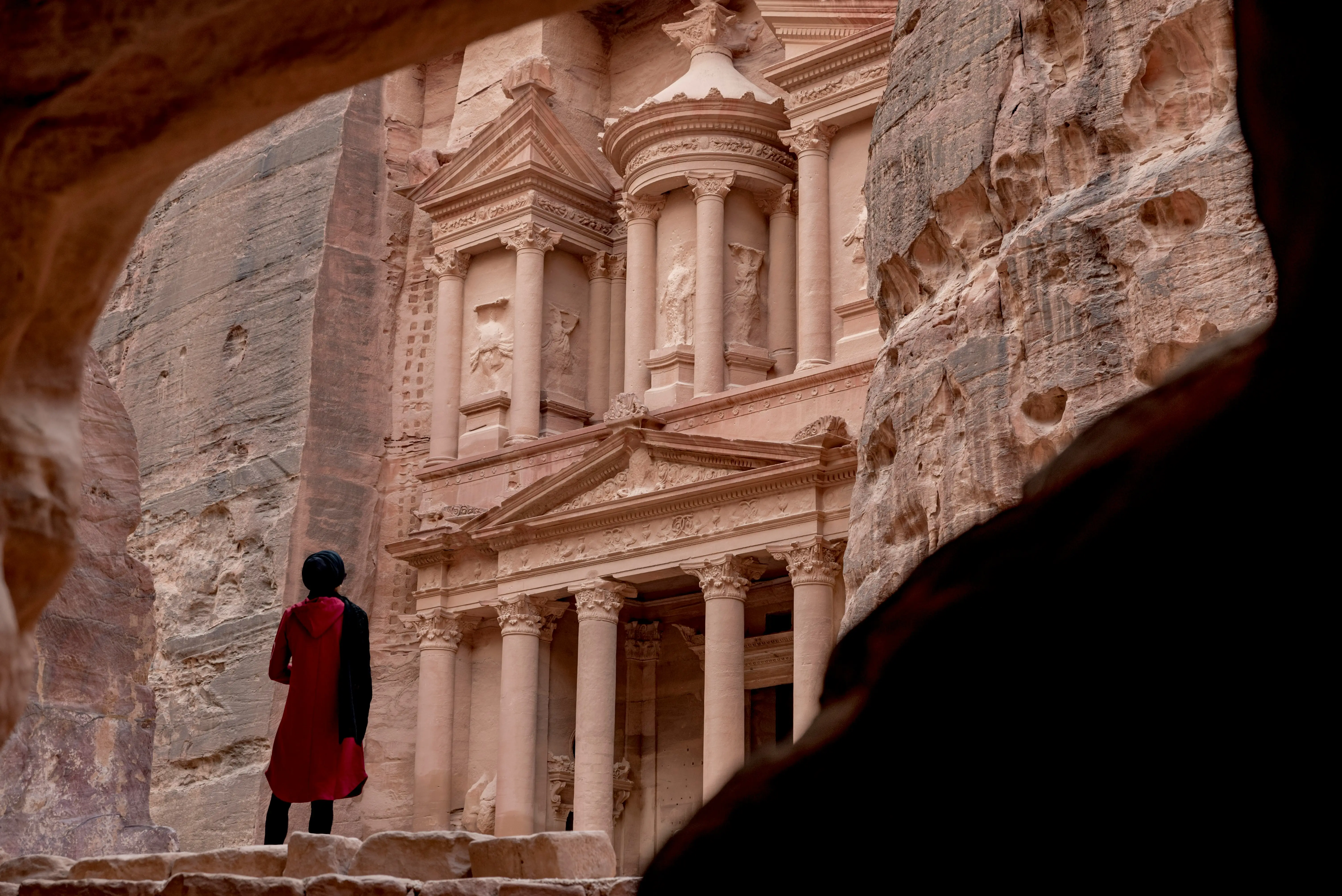
On this day, a special guide will take you along the same route many have travelled before and you will feel as if you've journeyed into another world. You get to explore a city carved into stone, walk through a dim, narrow gorge called The Siq (a holy path filled with old and ancient relics of gods); a sophisticated water system has been placed on both sides of the gorge. Much more will be revealed to you as you walk until you reach The Treasury. And just like Indiana Jones in The Last Crusade, you will be mesmerised by what you see.
A whole city, carved from stone, will open up before you once you leave The Treasury. Everything is built from the rock face—houses, theatres, tombs, and facades. As the sun casts its rays onto these places and you watch other tourists stroll along discovering the hidden secrets of Petra, you will understand what life must have been like for the people living here—tranquil, bustling, and exquisite.
Things to consider:
The Monastery (Al–Dair)
This monastery is a one hour climb up 800 rock steps from the basin restaurant/museum area. Don't be intimidated by the ascent though; donkeys are available, but the essence of the experience for many people is in the walk itself.
While it is not as famous as the Treasury, the Monastery is considered one of the most impressive views at Petra. It is similar to the Treasury yet only larger (50m high x 45m wide). While containing much less decoration, it is still beautifully carved and worth every one of the 800 steps you took to reach it.
Wadi Araba Vantage Point
If you are a lover of scenic landscapes and breath-taking views, another part of your day should include this location. With just an extra ten minute walk from the Monastery, you will be happy you took the extra time. Here you will enjoy panoramic views of the Wadi Araba Valley. This walk can be extra rewarding for the bird watchers among the group as eagles populate this area in abundance.
High Places of Sacrifices
This is another place that is offered that provides the opportunity for both a close look into the faith of the Nabatean priests as it was used for animal sacrifice, and also provides a very spectacular view of the city below. Get yourself ready for 700 steps into the mountain (again donkeys can be hired for those looking for a ride up). Your trek up will begin in the area by the theatre near the Treasury.
Petra entrance fee: 50 Jordanian dinars.
Things to consider while in Wadi Musa town/Petra:
Petra night tours
What better way of viewing the Treasury than to see it lit up by hundreds of candles? Imagine the rose-coloured rock sparkling with hundreds of tiny dancing flames lighting your way throughout. You will enjoy drinking traditional Bedouin tea while traditional Bedouin music plays softly in the background.
The journey starts at the visitor centre, with candles lining the way to the Treasury. The candles give the journey a whimsical effect, while the only sound you hear is that of your own breath echoing in the Siq (gorge).
Petra by Night runs five nights a week, from Sunday to Thursday. The experience begins at 8:30 pm and ends around 10:30 pm.
Ticket: 30 Jordanian dinars per person. Children under the age of 10 can join free of charge.
Turkish bath
Whether you are tired after a long day of exploring the city of Petra, or if you are preparing for your night tour, a Turkish bath is a must for a true visitor's experience. Trust us, every muscle in your body will thank you. A renowned local family owns the baths where we will be taking you so you are guaranteed an authentic Turkish bath experience. Feel free to bring your suit with you, or if you have forgotten yours, one can be provided.
As you enter the first chamber, your masseur will greet you. You will then be cleaned with warm soapy water, and rinsed off by pouring warm water over your head. Next it's off to the steam room. The steam is mixed with a special blend of local herbs that will aid your breathing and also break down those sore muscles. It's a unisex bath so you and your friends can enjoy each other's company while in the steam room.
Afterwards, we're off to the hot stones where you can put your tired feet up, aiding your blood circulation (definitely needed after all those steps!). Once you're ready you can head back into the steam room to prepare for your massage. We conclude our time at the Turkish baths with a cool down, followed by some local herbal tea, before we head back to your hotel or off to dinner. This experience will leave you feeling relaxed and rejuvenated like never before!
Price: 24 Jordanian dinars for the full works.
Day Five - Wadi Rum
After breakfast you will continue your excursion into the majestic Wadi Rum. From Petra, it is around a one and a half hour drive to Wadi Rum along the King's Highway. You will be taken on a mountain road, up to an elevation of 1,600 metres above sea level where you will be able to observe valleys dotted with Bedouin settlements and their herds of livestock.
Once we reach Wadi Rum, our Bedouin friend Abu-Yosef will greet us at his home with traditional Bedouin tea (tea made with fresh sage and sugar). After your short rest, you will be set to explore the immense area of Wadi Rum while in the back of an old 4x4 truck, to discover a landscape that was once described by the British officer T. E. Lawrence as 'vast, echoing and Godlike.' This description wonderfully summarises the Wadi Rum experience.
You will notice how the mountains of rock just seem to melt under the sun's energy, and the tracks of camels, foxes, and wild dogs sprinkled on the wind-swept sand. The incredible silence will engulf you, making you feel like part of the landscape around you.
Later, you will be taken to one of the highest points in all of Wadi Rum to witness a spectacular sunset. Abu-Yosef will prepare us some more Bedouin tea, right in the desert sand, and leave us to watch the descending sun. As we welcome the moon, a whole new view of the landscape around you emerges and as the darkness creeps in, the sky lights up with millions of stars to cast a silvery light upon the entire world.
Wadi Rum entrance fee: 5 Jordanian dinars.
Things to consider while in Wadi Rum
- BBQ chicken lunch: a unique experience, as close as it gets to what the native Bedouins used to eat while in the desert (15 Jordanian dinars per person).*
- Camel ride: who can resist trekking through the desert on the back of a camel? Best done after sunset or during early sunrise (15 Jordanian dinars per person/per hour).*
- Horse ride: want to experience Wadi Rum as T.E. Lawrence once did? Then horse riding is something you cannot miss out on (35 Jordanian dinars per person/per hour).*
- Hot air balloon: a bird's eye view of this beautiful landscape (from 45–90 minutes). It starts at dawn every day, reservations usually need to be confirmed the day before, and rides are subject to weather conditions (130 Jordanian dinars per person).**
- Mountain hiking: a great way to truly immerse yourself in your surroundings; this trip usually takes a couple of days to see the entire desert (40 Jordanian dinars / 2 hrs flat, for the local guide).*
- Extra night: Wadi Rum is a peaceful and seemingly limitless place, so an extra night might be worth considering. You can negotiate the price with your guide at the time of your decision.
*Payable directly to the Bedouin owner. **Advance booking is required.
Day Six - Via Wadi Araba – Jordan Valley – Mujib Bridge – Dead Sea
After breakfast we will embark on a four hour drive to the Dead Sea. Driving along, you will observe another side of Jordan and see the diversity of the land around you as we pass by Wadi Araba. Sand dunes will emerge on both sides of the road as we progress towards the fertile land of the Dead Sea. The rich land of the Jordan Valley, which has been plentiful for the last 10,000 years, will start to unfold before you.
We continue our journey by descending quickly towards the lowest point on earth (423 metres below sea level), driving along the Dead Sea Highway we will pass by the Wadi Mujib Bridge, which faces an enormous gorge.
The Dead Sea: words can hardly describe this magnificent place, being one of the world's first health resorts for kings like Herod the Great and many others.
Today all you have to do is relax and float on your back, read your favourite magazine and enjoy the moment.
Things to consider:
When sun baking at the Dead Sea, it is popular for guests to cover themselves with mud and forget to use any sun protection. The sun's harmful UV rays are filtered due to the high atmospheric pressure in the area, therefore we'd like all our guests to be careful so that they can enjoy their entire experience.
Day Seven - Departure
After breakfast, you will be driven to the airport where we will bid you farewell; a staff member will take your luggage inside for you and wish you a safe and pleasant trip home.